menu

Emergency Tarping Service in St. Louis – 24/7 Response Within 90 Minutes of Your Call

When storm damage leaves your roof exposed, every minute counts. Pioneer Roofing St. Louis dispatches emergency tarping crews around the clock to stop water intrusion, prevent interior damage, and secure your property until permanent repairs begin.

Slider Image 1
Slider Image 2
Slider Image 3
Slider Image 4
Slider Image 5
Slider Image 7
Slider Image 8
Slider Image 9
Slider Image 10
Slider Image 11

Storm Damage Doesn't Wait for Business Hours in St. Louis

When severe thunderstorms roll through the Gateway City, they bring destructive straight-line winds, hail, and torrential rain that can strip shingles, puncture roof decking, and tear off entire sections of your roof. St. Louis experiences an average of 50 severe weather days per year, and the humid Mississippi River Valley climate means water intrusion leads to mold growth within 24 to 48 hours.

A compromised roof exposes your home or business to cascading damage. Rain pours directly onto insulation, ceiling drywall, electrical systems, and personal belongings. In historic St. Louis neighborhoods like Soulard and Lafayette Square, older homes with plaster walls and wood lath construction absorb water quickly, leading to structural decay that costs tens of thousands to repair.

Emergency roof tarp installation stops this chain reaction immediately. A properly installed temporary roof covering seals the breach, diverts water away from vulnerable areas, and buys you time to coordinate with your insurance adjuster and plan permanent repairs. Urgent roof tarping is not a permanent fix, but it is the critical first defense that prevents a manageable repair from becoming a total loss.

When you wake up to a damaged roof after midnight or discover storm damage on a Sunday morning, you need 24 hour roof tarping from a team that responds immediately. Storm damage roof tarping requires specialized equipment, trained crews, and the ability to work safely in dangerous conditions. Every hour you wait allows more water into your structure.

Storm Damage Doesn't Wait for Business Hours in St. Louis
How Professional Emergency Tarping Protects Your Property

How Professional Emergency Tarping Protects Your Property

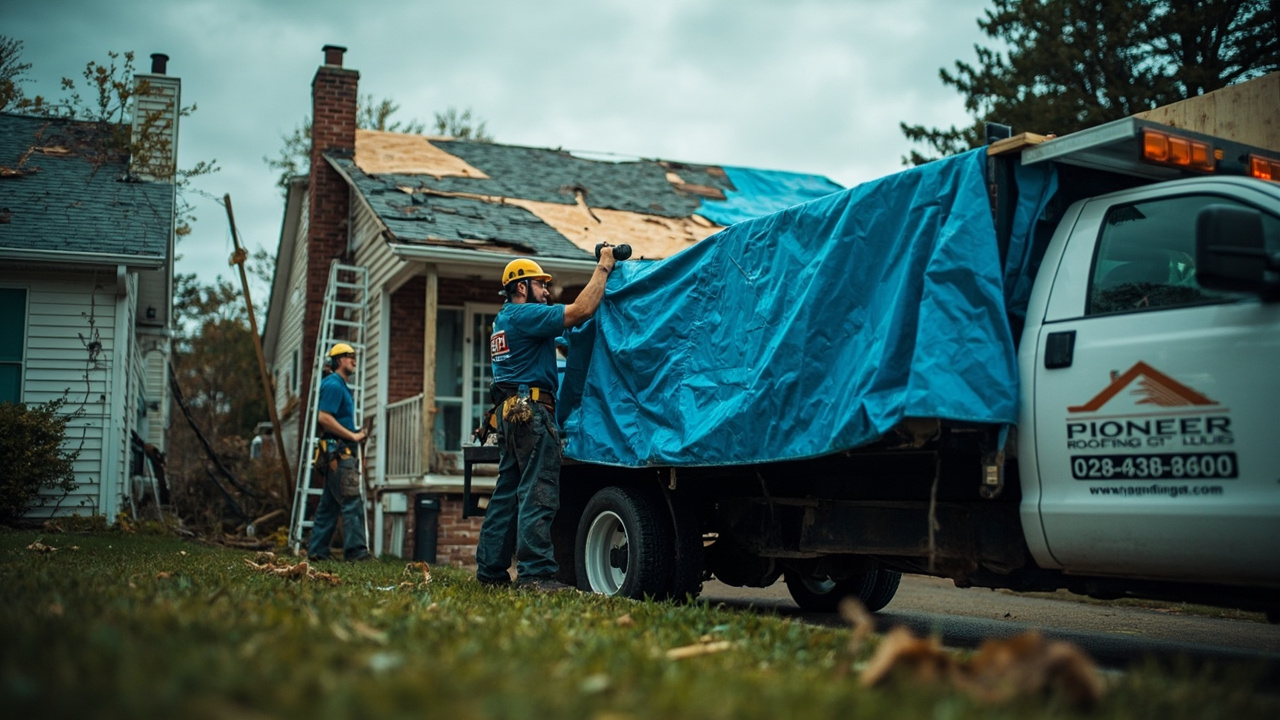
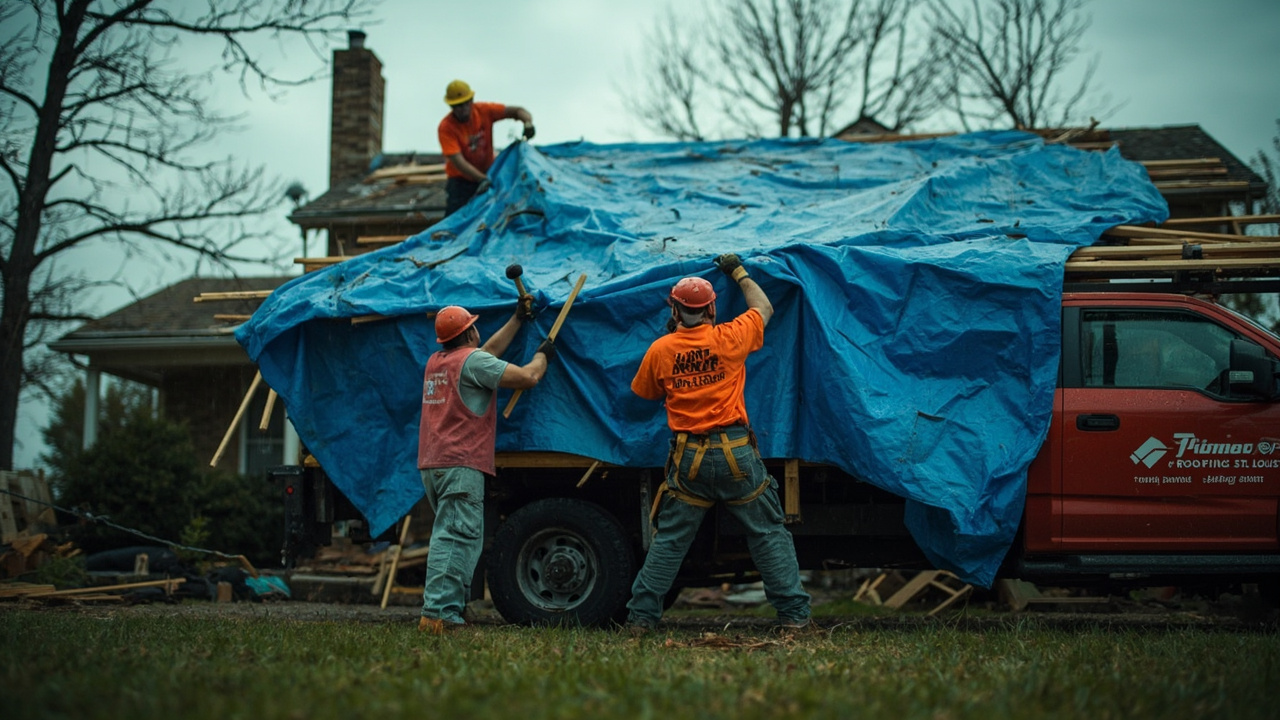
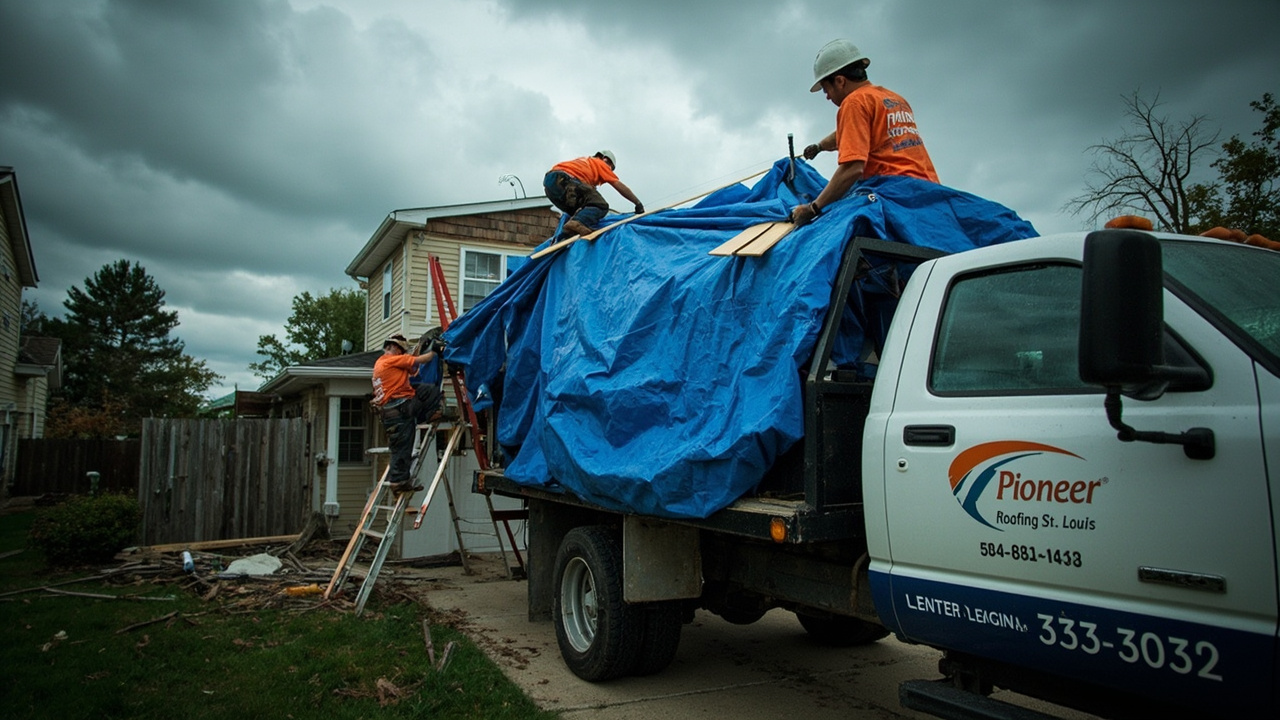
Emergency tarping is not about throwing a blue tarp over the hole and hoping for the best. Professional temporary roof covering services involve systematic damage assessment, proper anchor point selection, and installation techniques that withstand high winds until permanent repairs begin.

Our crews arrive with commercial-grade reinforced polyethylene tarps, not the lightweight tarps sold at hardware stores. We use 2x4 or 2x6 lumber to create secure anchor boards that distribute load across undamaged roof sections. Tarps get sandwiched between boards and fastened with deck screws driven into solid structural members, never just shingles or decking. This method prevents tarp failure during subsequent storms.

We extend tarps at least four feet beyond the damaged area in all directions to ensure complete coverage. Ridge vents, valleys, and penetrations like chimneys or skylights receive special attention, as water always finds the path of least resistance. If your roof has multiple damage zones, we install separate tarps with proper overlap to prevent channeling water into gaps.

For steep-pitch roofs common in St. Louis's Tower Grove and Shaw neighborhoods, our crews use OSHA-compliant fall protection systems. We work safely on wet, debris-covered surfaces at heights where one mistake means serious injury. We clear away loose shingles, broken flashing, and protruding nails before tarp installation to prevent punctures from beneath.

After securing the tarp, we document everything with photographs from multiple angles. This documentation proves to your insurance company that you took immediate action to mitigate further damage, which is required under most homeowner policies. We provide you with written confirmation of the work performed, materials used, and our assessment of underlying damage.

What Happens When You Call for Emergency Roof Tarping

Emergency Tarping Service in St. Louis – 24/7 Response Within 90 Minutes of Your Call
01

Immediate Dispatch and Assessment

You call our emergency line, and we dispatch a crew immediately, not in the morning or when convenient. Our technician asks targeted questions about the damage location, visible water intrusion, and safety hazards like downed power lines. We provide an accurate arrival window and call again when our truck is ten minutes away, so you know exactly when help arrives.
02

Strategic Tarp Installation

Our crew performs a rapid but thorough roof inspection to identify all compromised areas, not just the obvious damage. We verify structural integrity before walking on any section. We install heavy-duty tarps using the anchor board method, securing every edge and ensuring proper water runoff. The goal is complete weather protection that holds until we return for permanent repairs.
03

Documentation and Next Steps

Before leaving, we photograph the installed tarp system and provide you with detailed images of underlying damage visible during installation. We explain what we found, what the tarp accomplishes, and what permanent repairs will likely require. You receive written documentation for your insurance claim and a clear timeline for scheduling your full roof assessment once the emergency stabilizes.

Why St. Louis Property Owners Choose Pioneer Roofing for Emergency Tarping

When your roof fails at 2 a.m. during a thunderstorm, you need a company that actually answers the phone and sends a qualified crew, not an answering service that takes a message. Pioneer Roofing St. Louis maintains dedicated emergency response teams 365 days a year because we understand storm damage does not follow a schedule.

We know St. Louis roofing. The mix of architectural styles across the metro area requires different approaches. Bungalows in South City have low-pitch roofs with minimal attic ventilation, making water intrusion especially damaging. Mid-century ranch homes in Clayton and Webster Groves have wide overhangs and complex flashing details. Historic homes in the Central West End feature slate, tile, and multi-plane roofs that demand specialized handling.

Our technicians recognize these differences and adjust tarping methods accordingly. We understand local building codes and work directly with St. Louis-area insurance adjusters who know our reputation for thorough documentation and honest damage assessment. When we tell an adjuster what we found, they trust our evaluation because we have a track record of accuracy.

We also operate with transparency. Emergency tarping creates immediate costs, and we explain those costs upfront before starting work. If your insurance covers emergency mitigation, which most policies do, we provide the documentation you need for reimbursement. If you are paying out of pocket, we offer fair pricing for middle-of-the-night emergency response without gouging people in crisis.

Speed matters, but so does doing the job correctly. A poorly installed tarp that fails during the next storm leaves you with compounded damage and a new emergency. We install tarps that hold, document everything properly, and treat your property emergency like it is our own home.

What to Expect from Our Emergency Tarping Service

Response Time and Availability

Our emergency line routes to a live person who dispatches crews immediately, not during business hours. We maintain response times under 90 minutes for most of the St. Louis metro area, including St. Louis County, St. Charles County, and surrounding communities. During major storm events when multiple properties sustain damage simultaneously, we triage based on severity and safety risk. Active water intrusion and structural instability get priority. You will receive honest communication about arrival time, and we call with updates if conditions delay our crew.

On-Site Damage Assessment

Before installing any tarp, our crew performs a visual safety assessment of your entire roof. We look for sagging sections, compromised decking, and hidden damage beyond the obvious breach. If we identify structural concerns that make the roof unsafe to walk, we use alternative access methods or recommend immediate building evacuation. We take pre-installation photographs showing the extent of damage from multiple angles. This documentation protects you during insurance negotiations and helps us plan the permanent repair scope accurately once the emergency phase ends.

Quality of the Tarp Installation

We use only commercial-grade reinforced tarps rated for extended outdoor exposure and high wind resistance. Our installations involve lumber anchor boards, not sandbags or bricks that shift and fail. We secure tarps to structural members, ensuring wind cannot peel them back during subsequent storms. All edges get overlapped and sealed properly to prevent water channeling underneath. The finished installation looks professional and holds through multiple weather cycles until permanent repairs begin. You can trust your property is protected, not just temporarily covered.

Follow-Up and Permanent Repair Planning

Emergency tarping is the first step, not the final solution. After stabilizing your roof, we schedule a comprehensive inspection to assess all damage, photograph everything for your insurance claim, and provide a detailed written estimate for permanent repairs. We work directly with your insurance adjuster to ensure your claim covers all necessary work. If your insurance settlement comes in low, we provide supporting documentation showing why the full scope of repairs is required. We stay involved through the entire process until your roof is permanently restored.

Frequently Asked Questions

You Have Questions,
We Have Answers

How much does it cost to emergency tarp a roof? +

Emergency roof tarping in St. Louis typically costs between $300 and $1,500, depending on roof size, pitch, and damage extent. A single-story home with minor storm damage runs lower, while steep pitches or extensive hail damage increase labor costs. Most companies charge by the square foot or flat rate for emergency calls. If you file an insurance claim, your policy often covers tarping as immediate damage mitigation. Get tarping done within 24 hours after storms to prevent interior water damage and mold growth, especially during St. Louis's heavy spring rains and summer thunderstorms.

How to pay for a roof when you can't afford it? +

Start by filing an insurance claim if storm damage caused the failure. Most homeowners policies cover sudden, unexpected damage. If insurance does not apply, explore financing options like home equity loans, personal loans, or contractor payment plans. Many St. Louis roofing companies offer in-house financing or work with third-party lenders who approve customers with varying credit scores. Some manufacturers offer promotional financing with deferred interest. For severe financial hardship, check local emergency repair grants through St. Louis County or nonprofits. Avoid delaying repairs, as water intrusion worsens fast in our humid climate.

How much does insurance pay for tarping? +

Insurance typically covers the full cost of emergency tarping if storm damage caused the leak. Tarping falls under reasonable and necessary steps to mitigate further damage, which most policies require you to take immediately. Expect reimbursement for materials, labor, and emergency service fees, usually deducted from your overall claim payout. Document everything with photos, receipts, and timestamps. In St. Louis, where severe weather strikes frequently, insurers expect fast action. Do not wait for an adjuster to approve tarping first. Delaying protection can give insurers grounds to deny secondary water damage claims.

Will Fema put a tarp on my roof? +

FEMA does not directly install tarps on residential roofs. The agency may provide financial assistance through disaster relief grants if the President declares your area a federal disaster zone, but you arrange and pay for repairs yourself, then apply for reimbursement. FEMA's Blue Roof Program primarily serves coastal hurricane zones, not the St. Louis metro. After severe storms, you must act fast and hire a local contractor for emergency tarping. Your homeowners insurance is your first resource. If you lack coverage and qualify for FEMA aid, funds arrive weeks later, long after you need immediate roof protection.

How much to put a roof on a 2000 sq ft house? +

A full roof replacement on a 2,000 square foot St. Louis home typically costs $8,000 to $15,000 for asphalt shingles, depending on pitch, layers removed, and material quality. Metal roofing runs higher, architectural shingles cost more than three-tab, and complex rooflines with multiple valleys increase labor. This question often comes up after emergency tarping when homeowners realize repairs are not enough. If storm damage is the cause, insurance should cover replacement minus your deductible. Always get multiple estimates and verify contractors are licensed and insured, especially after severe weather when storm chasers flood the area.

Will insurance cover a 10 year old roof? +

Yes, insurance typically covers a 10-year-old roof if storm damage is the cause, not wear and tear. Policies cover sudden, accidental damage like hail impacts, fallen trees, or wind-lifted shingles regardless of age. However, expect depreciation adjustments. Insurers may reduce payouts based on remaining lifespan, especially if shingles show prior weathering. In St. Louis, where freeze-thaw cycles and summer hailstorms accelerate aging, document pre-storm condition with photos. If damage is solely age-related deterioration, expect denial. Maintain records of inspections and maintenance to prove you properly cared for the roof.

How old may a roof be before insurance claims it's too old? +

Most insurers consider roofs too old for full replacement coverage after 15 to 20 years, though policies vary. After this threshold, carriers often switch from replacement cost coverage to actual cash value, which factors in depreciation. Some companies deny coverage entirely for roofs older than 20 years unless recently inspected and certified. In St. Louis, asphalt shingles typically last 18 to 25 years, but humidity and storm exposure can shorten lifespan. Review your policy annually and consider proactive replacement before hitting age limits. Older roofs may still get covered for sudden storm damage, just at reduced value.

What credit score is needed for a roof? +

Many roofing financing options accept credit scores as low as 600, though rates and terms improve above 680. Some St. Louis contractors offer in-house financing with flexible approval, while third-party lenders like GreenSky or Enhancify serve subprime borrowers. Expect higher interest rates and shorter terms with lower scores. If your credit is poor, consider a co-signer, home equity loan, or personal loan from a credit union. Emergency tarping and minor repairs may not require financing at all. Always compare APRs and avoid high-pressure contractor financing. Your insurance claim may eliminate the need for loans entirely.

Can I pay monthly for a new roof? +

Yes, many St. Louis roofing contractors offer monthly payment plans through in-house financing or third-party lenders. Options include fixed installment loans, promotional zero-interest periods, or longer-term plans with competitive APRs. Approval depends on credit score and income verification. Monthly payments make expensive replacements manageable, especially if insurance does not cover the full cost. Read terms closely and watch for deferred interest traps where unpaid balances get hit with retroactive charges. Some contractors also accept credit cards. If storm damage caused the need, exhaust your insurance claim first before committing to financing unnecessary out-of-pocket costs.

What can I use instead of tarping my roof? +

If tarping is not feasible, consider emergency roof patches using rubberized sealant, roof cement, or peel-and-stick membrane over small punctures. For missing shingles, install temporary flashing or plywood sheathing secured with roofing nails. These methods work short-term but are not substitutes for proper tarping on large damaged areas. In St. Louis's unpredictable weather, tarps offer the fastest, most reliable water barrier until permanent repairs happen. Avoid duct tape, plastic sheeting without anchoring, or leaving damage exposed. If you cannot safely access your roof, call a professional immediately. Delaying protection invites mold, structural rot, and insurance complications.

Why St. Louis's Severe Weather Patterns Make Emergency Tarping Critical

St. Louis sits in a severe weather corridor where Gulf moisture collides with continental air masses, creating explosive thunderstorm development. The region experiences frequent derechos, straight-line wind events that generate hurricane-force gusts capable of stripping shingles and tearing off entire roof sections in seconds. Spring and summer bring large hail that punctures shingles and damages flashing. Winter ice dams form along eaves when snow melts and refreezes, forcing water under shingles and into attic spaces. These weather patterns create year-round roof vulnerability that demands immediate response when damage occurs. The high humidity along the Mississippi and Missouri River valleys accelerates mold growth after water intrusion, making rapid tarping installation essential for preventing secondary damage that often exceeds the original storm destruction.

Pioneer Roofing St. Louis maintains relationships with local building inspectors, insurance adjusters, and emergency management coordinators throughout the metro area. We understand the permitting requirements for roof repairs in different municipalities and historic districts. When major storm events impact multiple neighborhoods simultaneously, we coordinate with local authorities to prioritize properties with the most severe damage or vulnerable occupants. Our crews know the architectural styles and common roofing materials across St. Louis neighborhoods, from the clay tile roofs in affluent areas to the asphalt shingle systems common in suburban developments. This local expertise means faster, more effective emergency response tailored to your specific property type and location within the region.
Roofing Services in The St. Louis Area

Pioneer Roofing is proud to serve the entire St. Louis metropolitan area and surrounding communities. Our local presence means we are always nearby and ready to respond quickly to your roofing needs, whether you are located in the heart of St. Louis or the greater county. View our location and service radius on the map to confirm we cover your neighborhood and then call us to schedule your service!

Address:
Pioneer Roofing St. Louis, 1031 Lami St, St. Louis, MO, 63104

Additional Services We Offer

Our news updates

Latest Articles & News from The Blogs

Can You Actually Install a New Roof Over Your Old Shingles? Roofing a home in St. Louis comes with unique…

Can You Actually Install a New Roof Over Your Old Shingles?

Can You Actually Install a New Roof Over Your Old Shingles? Roofing a home in St. Louis comes with unique…

Why Your Neighbors in Manchester are Choosing Impact Rated Materials

Why Your Neighbors in Manchester are Choosing Impact Rated Materials Living in Manchester means dealing with the unpredictable St. Louis…

Preparing Your Roof for the Sudden Shifts of St. Louis Weather Patterns

Preparing Your Roof for the Sudden Shifts of St. Louis Weather Patterns Your roof faces more than just rain and…

Contact Us

Your roof is damaged, and water is getting in. Every minute increases the destruction inside your home or business. Call Pioneer Roofing St. Louis now at (314) 417-7774. We answer 24/7, and our crews respond immediately to stop the damage.